
Fauxbroidery vs. Embroidery on Caps
Both look great on a structured cap. The right choice depends on your design, your quantity, and what your customer actually needs. Here is the full breakdown without the sales pitch.
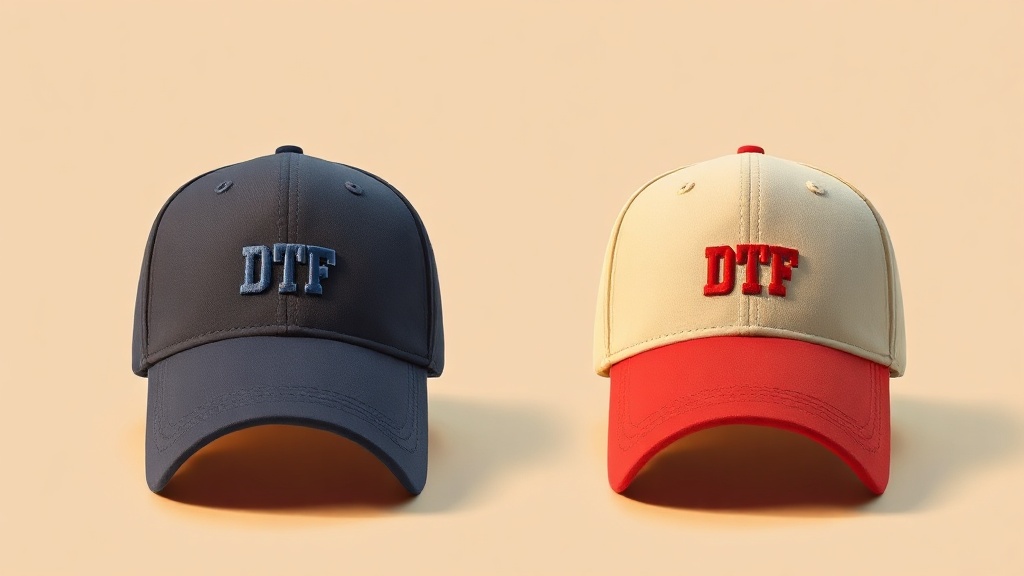
What Each Process Produces
Machine embroidery: thread stitched directly through the cap fabric, permanent by nature, with a dimensional look that comes from the physical stitch structure. True 3D puff adds foam under the stitches for additional height above the cap surface.
Fauxbroidery: a heat-applied DTF transfer printed with raised, textured inks that simulate the embroidery look when viewed from a normal distance. Applied with a cap press in under 20 seconds. The raised surface is physically present and tactile, not a flat print.
Design Complexity
Embroidery on caps has firm design constraints. Fine lines below 2mm, photographic elements, and high color counts all require either simplification or a digitizing compromise that changes the original artwork. A logo that prints cleanly as a fauxbroidery transfer may need a near-total redesign to embroider well on a curved cap front.
Fauxbroidery reproduces the original artwork at full color fidelity without digitizing compromise. A 10-color logo with gradients and fine detail prints as a fauxbroidery transfer exactly as designed. This is the primary technical advantage for complex artwork.
Cost Structure
Machine embroidery pricing is per-stitch. A typical 5,000-stitch left chest cap logo runs $8 to $14 per unit at low quantities, dropping to $4 to $7 at 144 pieces depending on the shop.
Fauxbroidery from GoldenDTF prices by the square inch at $0.06 base, scaling to $0.03 at volume. A 3 x 2.5 inch transfer is 7.5 square inches, costing $0.45 each at base rate. Press labor is roughly 30 seconds per cap. Total cost per decorated cap is materially lower than embroidery at most production quantities.
Durability on Caps
Both hold up well on caps that are not industrially laundered. The cap itself typically wears out before a properly pressed fauxbroidery transfer fails under normal use. For safety caps, workwear headwear, or caps going through industrial wash cycles at high temperature, traditional embroidery is the more durable specification.
The Bottom Line
For most promotional, retail, and branded merchandise cap programs, fauxbroidery delivers equivalent visual results at lower cost per unit and significantly greater design freedom. For workwear or applications requiring extreme wash durability, recommend traditional embroidery. The two methods are not in competition for the same job. They serve different ends of the same market.
Sadie also wrote about