DTF Gang Sheet
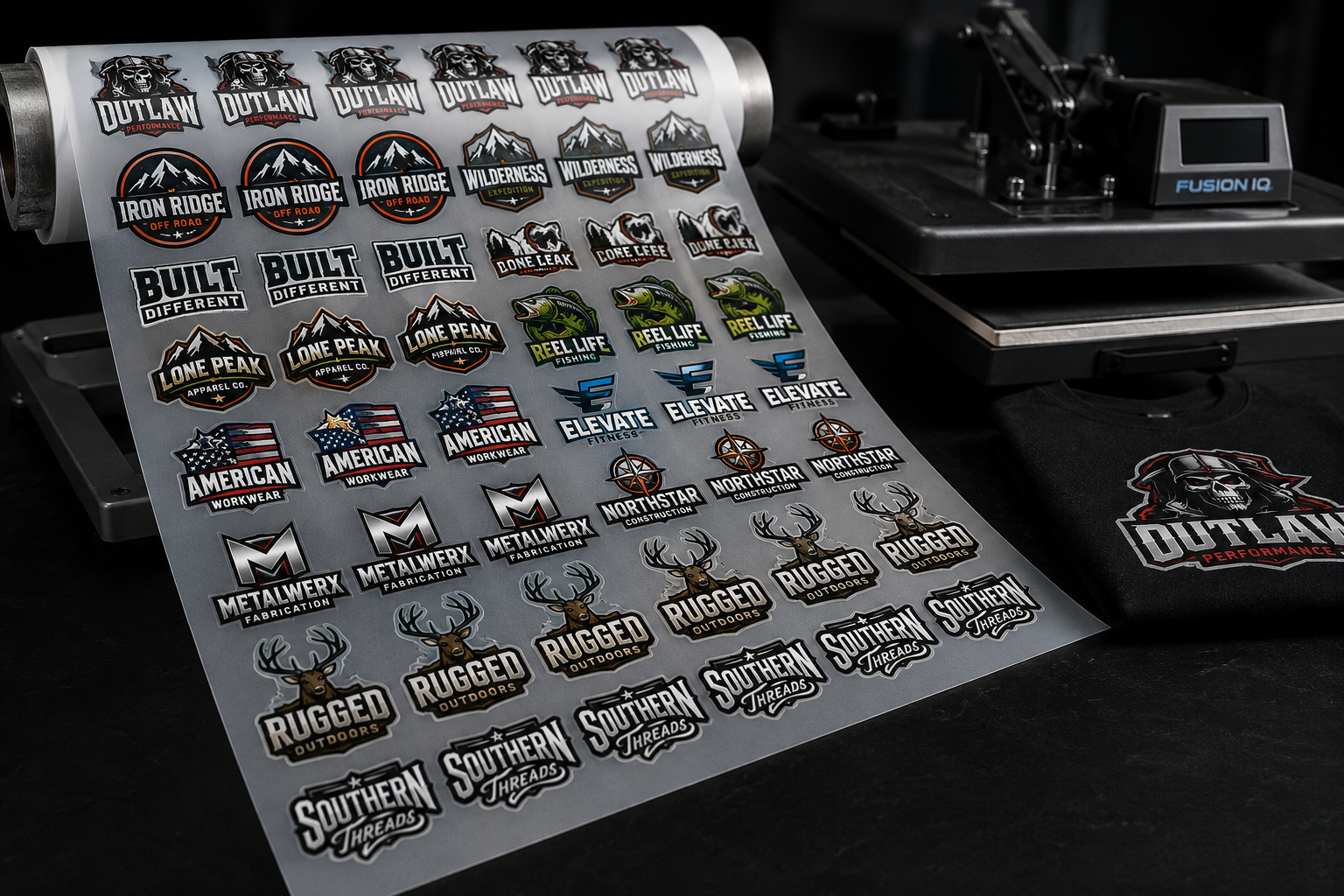
Load your artwork into the builder, drop it onto a 14 inch wide sheet, and pack the layout as tight as our 0.25 inch spacing rule allows. Denser packing lowers your effective cost per design because you pay for sheet area, not design count. Pick your length: 18, 24, 36, 48, 54, or 72 inches. Pricing is $0.06 per square inch of sheet area, so a 14 by 24 sheet is $20.16 whether it holds one logo or thirty. Prints survive 50-plus home wash cycles when pressed at 285 to 325 F for 10 to 15 seconds with medium-firm pressure. Add pre-cut contouring at $0.29 per transfer if you want to skip weeding at the press. Order by 1 PM Eastern on a weekday, it ships the same day.
Select Size
Quantity
Common Questions
- One large sheet, many designs tiled across it. You pay for the sheet area at $0.06 per square inch, not per design. A 14 by 24 sheet with three left-chest logos is the same $20.16 as the same sheet packed with thirty logos. That is why gang sheets exist: pack your job dense and your effective cost per print drops the more designs you fit.
- Open the builder, drop your PNGs or SVGs onto the canvas, then drag, resize, and rotate each one until the sheet is packed. Nudge designs against each other until they hit the 0.25 inch spacing minimum: the builder will not let you go closer, that gap is required for the powder station and the cut path. Rotate long horizontal designs 90 degrees when they fit tighter that way. When the layout looks right, add to cart.
- Every DTF gang sheet is 14 inches wide. Pick the length: 18", 24", 36", 48", 54", or 72". A 14 by 24 lands at $20.16 at the $0.06 per square inch rate. Need something longer or a non-standard length, email orders and we will quote it.
- 0.25 inch minimum between any two design edges. That gap covers our cutter tolerance and keeps adjacent designs from fusing together when the sheet moves through the powder shaker and the cure oven. The builder enforces it automatically. Go tighter than that and the cut lines drift into your neighbor's artwork, which is not fixable at press time.
- Yes. A gang sheet is agnostic to who owns the artwork. Shops routinely combine jobs from four or five clients on one 14 by 72 sheet to hit the best per-design economics, then trim and sort the finished transfers by client after the sheet arrives. Nothing about production changes when you mix jobs.
- 300 DPI at final print size. If a file lands at 600 DPI we downsample on intake, no penalty. If a file is under 300 DPI we flag it before it prints so you decide whether to send a cleaner file, run a vector trace through the Vector Credit Pack, or accept the softness. We do not silently print a low-res file and hope you do not notice.
- $0.06 per square inch of the whole sheet, no design count involved. A 14 by 24 is $20.16 whether it holds one design or fifty. Pack dense, cost per design drops. Pre-cut contouring is $0.29 per finished transfer if you want us to cut around each design so nothing needs weeding at the press.
This product earns its price for these shops.
Print-on-demand shops running mixed drops
You have 20 to 200 designs across dozens of customers, each with a specific size. You want to hand-place every one so the sheet cuts clean and nothing gets tossed.
Etsy sellers ganging their own catalog
You know your catalog cold. You want to squeeze the maximum coverage out of a 22 by 24 sheet by tucking small back-print logos into the gaps around the big front designs.
Screen printers using DTF for one-offs and short runs
You already own a heat press and a rotary cutter. DTF gang sheets fill in the gap under 24 units where screens do not make sense. The canvas builder lets you nest client logos exactly the way you would burn a screen.
Boutique apparel brands doing sampling and re-orders
You are running sizing runs, color-way samples, and repeat drops off a single sheet. Manual layout lets you group by size so cutting sorts itself.
Anyone with a specific bleed, spacing, or registration need
Auto-build packs for density. If you need a specific gutter around each print for hand-cutting or for a specific application substrate, the canvas is the only way to get it.
If any of these describe you, buy something else.
We would rather steer you to the right product than have you return the wrong one. Each row links to what to buy instead.
You have one design, one size
A single 11 by 14 chest print is a By-Size transfer, not a gang sheet. You will pay a sheet-level minimum you do not need.
Try Custom DTF Transfers by SizeYou want us to do the arranging
If you would rather upload files and let a packer tile them, use Auto-Build. Same base rate, no canvas time.
Try Auto-Build Gang SheetYou are printing on rigid, non-porous surfaces (tumblers, glass, mugs)
DTF is heat-applied to fabric. For hard goods you want a UV-DTF gang sheet, cold-peel, no press.
Try UV-DTF Gang SheetYou need reflective, foil, glow, or puff on the same sheet
Standard DTF gang sheets are single-pass CMYK plus white. Specialty inks run on their own sheets to hold the effect.
Try Foil DTF Transfers
Every fabric family, ranked by how this transfer behaves.
Cotton (100%, ringspun and open-end)
The reference substrate. Presses at 300 to 315 F for 12 seconds, warm peel, no scorch, no dye migration. Runs the highest opacity of any fabric family.
50/50 and 65/35 cotton-poly blends
Presses at 300 F, 10 to 12 seconds. Slightly softer hand than 100% cotton. Watch for dye migration on hot-coral, red, and royal blends, drop to 285 F and 15 seconds if you see ghosting.
Tri-blends (cotton/poly/rayon)
Presses at 285 to 295 F, 10 to 12 seconds, firm pressure. The rayon runs soft, so the transfer sinks into the fabric for a vintage hand. Excellent for boutique retail.
100% polyester (event tees, athletic)
Presses at 280 to 285 F, 10 seconds max, firm pressure. Any hotter and the white ink underbase can push the polyester dye through. Pre-press the shirt 3 seconds to release moisture before laying the transfer.
Fleece, French terry, canvas totes, twill caps
All press at 315 F, 15 seconds, warm peel. Add 3 seconds of post-press through a Kraft cover sheet for extra bite on brushed surfaces.
Film, ink, adhesive.
- Every Golden DTF gang sheet is printed on 90-micron hot-peel film with a matte PET carrier. The film is calibrated for a warm peel window between 300 and 325 F. Peeling cold works but takes longer and the corners can lift on tight-radius designs.
- Ink chemistry is a water-based CMYK plus a heavy white underbase, cured with commercial hot-melt adhesive powder. The finished transfer is soft to the touch, matte, and stretches with the garment up to about 15% elongation before micro-cracking becomes visible.
- Print resolution is 1440 by 1440 dpi. Fine text stays readable down to about 6-point at the standard 300 dpi source. Halftones and photographic gradients render cleanly, no visible banding on skin tones.
- Wash durability: field-tested to 50-plus cycles at warm wash, tumble low, inside out. No cracking, no color loss, no adhesive edge lift. The failure mode when it comes is always the fabric giving way first.
On the shirt, on the shipment.
- Sheet stock: 22 inches wide by whatever length you build, up to 96 inches per sheet. The 22 by 24 anchor size is what most shops default to because it slots into a 16 by 24 press with room to breathe.
- Film weight per sheet is roughly 3 to 5 ounces once packed. Ships flat between chipboard, never rolled, never folded. Rolled DTF loses adhesive contact at the corners after 30 days on the roll, so we do not ship it that way.
- Hand feel after press: softer than screen print, softer than plastisol, comparable to a light water-based screen print. Not detectable through a cotton tee at arm's length. Detectable on a lightweight tri-blend if you rub your thumb across it.
- Stretch tolerance: 15% elongation before you see hairline cracking. Pushing further is a design choice. Athletic wear and leggings should use small, distributed elements rather than one solid block across the stretch axis.
How this stacks up against the alternatives.
Auto-Build Gang Sheet
Same wholesale rate, same 24 hour ship. Skip the canvas, upload files, we tile for max density. Pick this when arranging is a chore, not a craft.
See Auto-Build Gang SheetCustom DTF Transfers by Size
One design, one size, priced strictly by the bounding box. Pick this when a full sheet is overkill and you just want the one chest print.
See Custom DTF Transfers by SizeUV-DTF Gang Sheet
Cold peel, no heat press, bonds to glass, metal, and hard plastic. Pick this the moment your target is a mug, a tumbler, or a phone case instead of a shirt.
See UV-DTF Gang SheetFoil DTF Transfers
Metallic gold, silver, holographic, rose gold, over the top of standard DTF. Pick this when you need a reflective element that CMYK cannot fake.
See Foil DTF Transfers
Real jobs this ships for every week.
- Etsy stores batching a weekend's orders across sizes and colorways
- Screen shops filling in under-24 unit reorders without burning a new screen
- Custom apparel shops sampling color-ways before a bulk run
- School spirit programs pressing team logos, player names, and back numbers off one sheet
- Restaurants and gyms running staff shirts, front left chest and full back logo pairs
- Boutique brands doing 10 to 50 unit drops with rotating designs
- Sublimation and DTG shops adding a cotton solution to a poly-only workflow
- Print-on-demand fulfillment shops batching orders end-of-day for a 24 hour ship promise
Get your files right, get the print right.
File type
PNG with transparent background is the reference format. TIFF and PSD flat work. JPG is workable if there is no white or transparent background needed, but you will lose the crisp edge on curved shapes.
Resolution
300 dpi at final print size. If you scale up a 72 dpi mockup to sheet size, the RIP will smooth it and you will see the softness in the printed transfer. Skip the guess, export at 300 dpi.
Color mode
RGB. Our RIP handles CMYK conversion with a calibrated profile. Uploading pre-converted CMYK strips gamut we would otherwise print.
Line weight and text
Minimum 1 point line weight, minimum 6 point text at final size. Reversed white text under 8 point can fill in on the underbase. Bump up or thicken if unsure.
Transparency and effects
Drop shadows, glows, and gradients render at print. Keep semi-transparent layers to real opacity values, not blended blending modes, or the RIP will flatten unpredictably.
Everything shops ask before ordering.
How is a gang sheet priced?
How much can I fit on one sheet?
Can I mix different designs on one sheet?
Do I have to pre-cut each design?
What happens if I leave empty space on my sheet?
How fast does it ship?
Can you build the gang sheet for me?
What if a print peels or cracks in the wash?
Related products, guides, and industries.
Related Products
Buying Guides