
How to Set a Uniform Budget Per Employee
A per-employee uniform budget that includes blanks, decoration, initial issue, and annual replacement is the difference between a program that runs on autopilot and one that triggers a budget conversation every quarter.
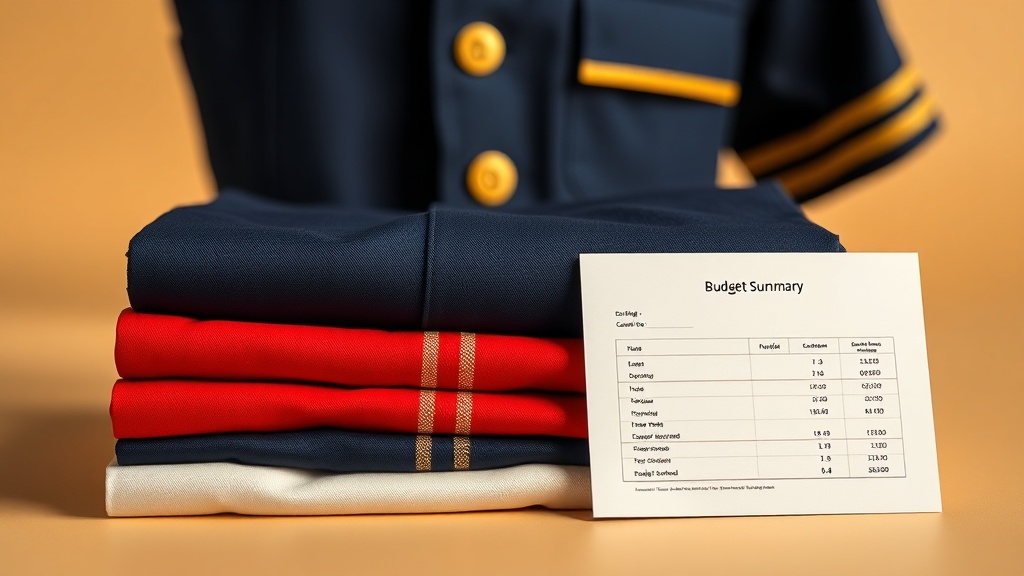
What Goes Into the Per-Employee Number
The per-employee uniform budget has four components: the initial issue cost (blanks plus decoration for the garments issued on hire), the annual replacement cost (attrition-driven reorders), any program overhead (storage, laundry allowances, or pressing equipment amortized per person), and the cost of a refresh cycle if one is planned.
Most businesses calculate only the initial issue cost and then wonder why their uniform budget is blown by June. The full per-employee number includes everything that touches the uniform program over a 12-month period.
Typical Ranges by Industry
Food service: $80 to $160 per employee per year, depending on role, garment quality, and turnover rate. Retail: $60 to $120 per employee per year. Corporate office: $40 to $90 per year. Healthcare and hospitality sit higher because of volume, frequency of issue, and strict presentation standards.
These numbers assume two to three garments issued per employee and a 15 to 25 percent annual replacement rate. If your turnover rate is above 50 percent annually, your real per-employee cost will be higher because replacement cost scales with turnover.
The Decoration Cost Line Item
DTF decoration for a standard left chest logo on a polo runs $0.74 per shirt at the base rate of $0.06 per square inch. At the $150 volume threshold (17% discount), that drops to $0.61. At $250 (22% discount), it is $0.58. The per-shirt decoration cost is small relative to the blank cost, but it adds up when you are running a program of 30 or more employees.
Build the decoration cost into your per-employee budget at the volume discount tier you expect to hit on a quarterly batch order. Do not budget at base rate if you are ordering 40-plus shirts per quarter. You will consistently overspend on paper and underspend in reality.
Annualizing the Budget Correctly
Divide your annual program cost by average employee count for the year, not the employee count at January 1. If you start the year with 20 employees and end with 28, your average headcount is 24. Dividing total program cost by 24 gives you an accurate per-employee figure.
Track this number for two to three years and you will see your own attrition pattern. That pattern is more valuable than any industry benchmark because it reflects your specific operation, turnover profile, and garment choices.
Sadie also wrote about